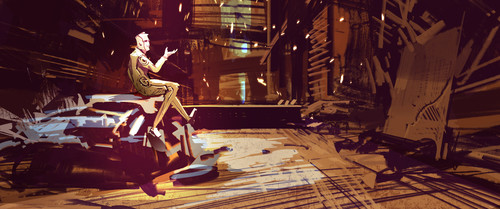
Primal Pathways in depth

Today’s World of Legacy is Primal Pathways, written by Laurence Phillips and illustrated by Juan Ochoa.

Primal Dawn

Primal Pathways begins at the dawn of life. As alien creatures make their first trembling steps onto land, they find ethereal spirits waiting for them: denizens of the Primal Plane, Guardians formed of the raw energy and power of life. Each spirit, focused on one aspect of life, picks a species to uplift, granting them sentience. So your first choice as a player is twofold: what sort of creatures are you, and who was the Guardian who uplifted you?

So, maybe you’re a herd of armoured elephantine creatures, empowered by the Devourer – the Guardian that favours creatures who consume without pity or remorse. Or perhaps you’re a hive of flying, stinging insects, chosen by the Hunter – the Guardian of those that seek out greater and greater challenges for their skills. Or maybe you’re a nimble race of tunnel-dwelling scuttling rodents, who draw on the genetic memory of their ancestors as they follow the edicts of the Otherworldly – Guardian of those that seek to understand the metaphysics of the world.


As you begin your game, your species barely know what it means to be people rather than animals. To guide them, you have a viewpoint character – maybe a Chosen, particularly empowered by the Guardian, or a Magus able to channel the Primal Plane. As you form new bonds with the other characters and explore this new world, you’ll improve your tribe’s lot – pushing back the threats that menace them, getting the resources they need to grow and prosper. Or maybe you run into problems, and things go badly for the tribe. How you’re tribe’s doing has its greatest impact when the Evolution move is triggered and generations rise and fall. If your mood is high, you can choose between experiencing fortunes or evolving new traits. If mood is low, you can only evolve if you also experience calamities.

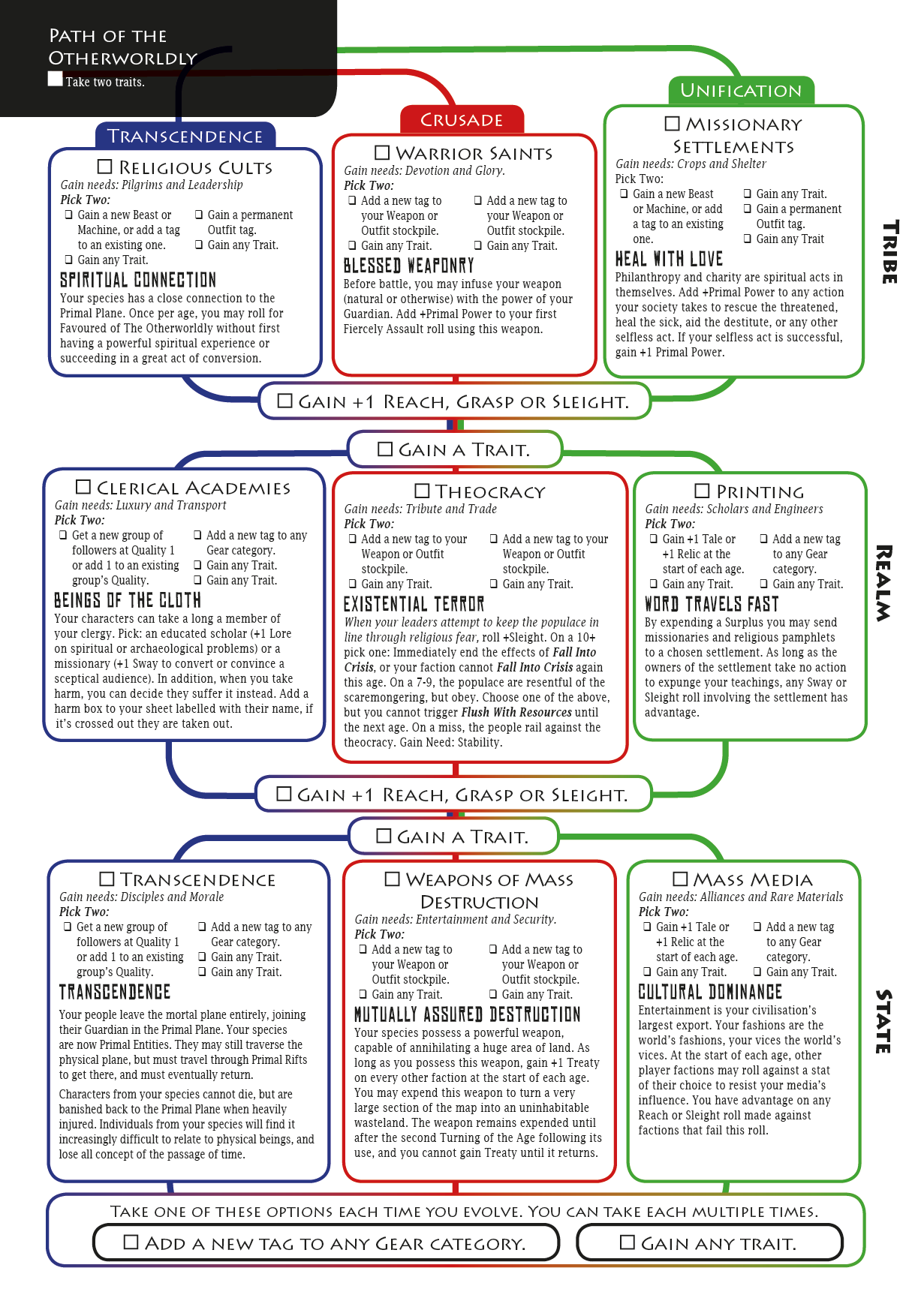
Each Guardian has its own tree of evolutions, split into three pathways. Here’s the Builder‘s. Each evolution is another choice from the next tier, giving your creatures new traits, making your people more effective when working together, or giving them entirely new moves.
When you pass thresholds in the tree your People reach new stages of development, from Tribe to Realm to State. Making each jump brings new powers and new tags for your gear, but also its own problems. How will your people deal with a new need for Alliances, Mass Media, Energy?


And as your People become more and more advanced, maybe they start toying with the fabric of reality with Primal Pathway‘s new Wonders – The Grand Temple, The Primal Gate, even repeating the uplifiting process on another species with A New Awakening.


So that’s Primal Pathways – telling the story of how your People evolve, and how their way of life shifts and mutates as the scope of their society exponentially grows.

But maybe you don’t want to be the servants of intangible spirits. Maybe you want to play the gods themselves – or their servants. If so, tune in tomorrow, when I’ll be talking about Godsend.

Worldfall in depth

As promised yesterday, it’s now time to talk about Worldfall – written by Katherine Cross and illustrated by Claudia Cangini and Tithi Luadthong.

At the start of a game of Worldfall, you have just founded a colony on an alien world. The trip has been extensive and transformative, and the first thing you decide is the politics your cabal of colonists formed during the journey.

Maybe they were the Officer Class, in charge then and looking to keep control now? Or the Workers Intergalactic, the labourers keeping the ship – and now the colony – running and finding solidarity with each other?

The Officer Class
The Workers Intergalactic

Or maybe they tended to the culture of the ship, whether they’re the new religion of the Keepers of the Flame or the anarchist upstarts of the Scum of the Universe?

The Keepers of the Flame
The Scum of the Universe

Together, you build your cabals, making choices about the society of the fledgling colony and the world you have landed on. It’s a strange and wonderful land, bursting with life. What will you make of it? To answer that, you make Characters. Each character is the key viewpoint we have from that Cabal at this moment in time. You could go with a match for your Cabal (a Gasoline Fire from the Scum, maybe?) or something that’s orthogonal, like a Priestex from the Officer Class.

The Gasoline Fire
The Priestex

Your character explores the new world, makes deals with other factions, builds grand art projects and battles for the soul of the colony. As they do so, they’ll win or lose your Cabal points of Reputation – a marker for their influence over colony society. You play in this mode until someone completes Worldfall‘s signature Wonder – the Constitutional Convention. Once it’s completed, you all take turns to choose the colony’s negative and positive liberties. What things does it swear to provide its citizenry? What does it forbid? Each choice comes with its own government institution that you now control, as well as effects on the wider colony. Once you’ve divided them up between you, you move the clock forward a generation – and see what your choices have resulted in.

That’s how Worldfall plays: shifting between the challenges of colony development and the struggle to build a more perfect union. As generations pass, will the colony grow and thrive? Or will it shatter and wither? And all the while, maybe the planet is pushing back: learning more about you, sending its own emissaries to interfere, and try to co-opt you into its own ecosystem. Particularly if someone has chosen to play the Worldsoul – the gestalt representation of life on this planet.

So, that’s Worldfall. Please do check it out! And if getting into the mindset of weird, alien life appeals, tune in tomorrow when I tell you about Primal Pathways.

Worlds of Legacy now out – plus Generation Ship in depth.

The Worlds of Legacy are now live! Check them out at our store – I’m very excited by the variety in these books, and the work my authors have put in. In celebration, I thought I’d dive a bit deeper into each of them in turn. First up – Generation Ship by Aaron Griffin and illustrated by Tithi Luadthong.

In Generation Ship, you’re trapped in the bowels of a titanic machine and the machine is freezing to death in the void of space. You aren’t meant to be here. You shouldn’t even exist, as your ancestors were meant to be unfrozen when the ship reached its goal. But still, you live.


So, what do you do? You have a family of fellow passengers, who have carved out ling space in the ship’s guts. Maybe they’ve set up algae tanks to feed the community. Maybe they protect and revere the still-unfrozen. Maybe they’re maintenance bots, jolted out of the programmed-in behaviour.

Your family has goals, friendly factions, enemies and needs. And that’s where your character comes in. They’ll delve into the ship’s tunnels, make threats safe, find the legendary ship systems, and restore – and control – them.

That’s the work of generations. Each generation the society on the ship changes, and you pick a different character type to show a different side of your family. Maybe a wise Advisor, a lethal Soldier, or even the void-empowered Touched.

So you’re telling the story over generations of how society survives and adapts to this hostile environment, and how your family repairs or claims control of one of the ship systems – the bridge, the dropships, navigation, sensors. What happens when you’ve fixed them all? Well, you face a final decision – where do you land, and what flaws are you willing to accept from your new homeland to finally feel the earth under your feet?

Of course, there are more stories you can tell once the ship has landed and the colony as formed – but that’s a different game. Maybe I’ll tell you about Worldfall next.

Coming Soon: Worlds of Legacy

With Legacy out now and physical books on their way, it’s time to talk about what’s next. We’ll be returning to Legacy’s post-apocalyptica soon, but first up we’re doing something new: Worlds of Legacy.

The Worlds of Legacy

Each one is a brand new setting for Legacy by a new author, bringing new playbooks, moves and ideas for your game. They’re slim books but pack a lot of ideas in there. Each of them draws on Legacy’s faction and character gameplay, and lets you tell a story over generations, but the stories you’ll be telling are completely different. I’m currently looking over the final art and texts for all five, and I’m really excited to share them with you!

Primal Pathways


Champions of The Otherworldly, one of the Guardians

First up is Primal Pathways, written by Laurence Phillips and illustrated by Juan Ochoa. Each player controls a species enlightened by an otherworldly Guardian and must guide the growth of their civilisation and the evolution of the creatures, from the dawn of sentient life to the development of cities, nations and more.

Your Guardian might be the Devourer, the Builder, or many more; your character might be an Emissary, a Chosen of their Guardian, or one of four other playbooks.

What I love about this book is the evolution mechanics Laurence put together: the many diverse traits let you create some really weird civilisations (Ambulatory slugs! Parasitic and carnivorous plants! Spiders building cities in a jungle canopy!), while the evolution trees each Guardian provides let you radically change your species as the ages turn while remaining true to its primordial origins.

Generation Ship

The Keepers of the Long Sleep venerate the still-sleeping saviours of humanity.

Next we have Generation Ship, written by Aaron Griffin and illustrated by Tithi Luadthong. Long ago, your ancestors boarded a starship that’d take them to a new colony under a distant star. Frozen in rows hundreds deep, they slumbered through the centuries – until something went wrong. Woken up too early, you must now scavenge and survive within the bowels of a slowly-dying ship.

In this game, your families are organisations within the City that the Awoken have formed in the ship’s tunnels. Your playbook could be The Alliance of Agronomists, bio-engineers keeping the ship fed; The Maintenence Collective, autonomous bots gone far from their original programming; or maybe The Throng of Pleasure, those who tend to the City’s vices. Your character, meanwhile, might be a Diplomat skilled at making the disparate factions work together; a Sleeper, a newly woken remnant of the ship’s original builders; or The Touched, who has made contact with the void outside the ship and has drawn strange power from it.

And as you play, you’ll be working towards your final arrival – seeking out the ship’s key systems, working out how they’ve gone wrong, and claiming them for your Family. Each activated system – from the Astrogation Arrays to the Dropships – gives your family particular advantages so long as they claim them, and brings you all closer to your final arrival at a place you can call home.

Worldfall

The Officer Class

Of course, getting to a new planet is only half of the struggle. When you arrive, what sort of society will you all build?

That question is the heart of Worldfall, written by Katherine Cross and illustrated by Claudia Cangini and Tithi Luadthong. It’s a game of political sci-fi in a new colony, with each player controlling an ideological cabal within the colony’s society. You might be the Officer Class, still clinging to their ship-borne authority in this new society; the Guardians of Eden, attempting to understand and protect the ecosystem of their new home; or the Scum of the Universe, agitators, provocateurs and artists partying on the fringes of society.

The Gasoline Fire

Worldfall is a game of reputation and favours. As your character deals with the colony’s problems – the Hero of the People winning fairer wages for the workers, the Gasoline Fire burning the midnight oil to create age-defining artworks, the Flag pushing back over-aggressive wildlife – your cabal will accumulate political capital they can use to get what they need. Defining all that is your Constitutional Convention – a brand-new Wonder that sets out the freedoms your colony enshrines in law and responsibilities it enforces. As you play the constitution mutates and changes, to match your colony’s expansion.

Godsend

Jess Taylor’s amazing cover!

Let’s depart from the shores of sci-fi, and head to a mythic land. A land where gods bicker in their heavens. Where their avatars face down armies single-handed, and where the end of days is fast approaching.

In Godsend, written by Khelren and illustrated by Jess Taylor and Tithi Luadthong, you’ll come together to tell a story of faith and despair in a mythic age. You’ll make your divinity – maybe a domineering god of Knowledge who’s the head of the Pantheon, or a conniving Trickster deity who everyone keeps at arm’s length. Then you’ll make an avatar – for another player’s god. Maybe you’re an Angel, sent by them on a mission? A Pandora, mother of monsters? Or a Prometheus, who has stolen power from their god and must somehow deal with their wrath?

Avatars carry out their god’s will.

Godsend is bringing a lot of interesting things to the table. First, you’ll have a built-in relationship with two other players: you’ll be the god of one, and the avatar of another. Second, it’s entirely diceless: as rulers of fate, it’s fitting that you’re unconstrained by random chance. Instead, your stats determine how many good things happen when you use your divine abilities – and how many calamities you avoid. Finally, you will fill your map with grand civilisations to lay low, armies to challenge, monsters that can rampage – escalating in scale and drama as the apocalypse approaches.

Rhapsody of Blood

The Holy Church stand firm against the darkness.

Every generation the blood moon rises, and the castle exalts a villain with its dark gifts. They shall command its legions, use its powers to twist reality, and seek the godlike power of the unholy grail.

In Rhapsody of Blood, written by me (James Iles) and illustrated by Adrian Stone, you are the ones here to stop them. Your bloodlines have fought the castle since its first emergence, and that legacy has granted you endless tenacity, strange powers, or unbreakable faith. Together, you will root out the wards of the castle where they have infested the mundane world, slay the acolytes of the castle’s regent, steal their dark power for your own and banish the regent and the castle with them.

But the castle is immortal, and the blood moon will rise again. As generations rise and fall, what tales of heroic action and gothic bloodshed will you tell?

The castle’s Regent sends their minions out to blight the land.

Look out for more details in the coming weeks as we get closer to these game’s release!

AprilTTRPGMaker: a month of interesting questions!

In the run-up to April, Kira Magrann (one of our authors for Legacy: End Game!) posted the image above – 30 questions for RPG designers to provoke thoughts and get us talking about our design process. I posted my answers on my twitter and G+ pages over the month; now that the month is over, I’m compiling the answers here. Enjoy!

1. Who are you?

Hello! I’m James, a research scientist in my late 20s living in Oxford, UK. I’ve been designing RPGs for just over 10 years now, starting with the 40-person, term-long parlour larps my uni society put on and branching out into pen and paper rpgs about 5 years ago with Legacy: Life Among the Ruins. Since then, under the UFO Press banner, I’ve released a few storytelling card games, a monthly stream of micro-RPGs on Patreon, and the Game Chef finalist Weave.
I try to draw inspiration from a wide range of sources: my training in disease ecology and evolution, a lifelong passion for reading sci-fi and fantasy, interesting mechanics from video games and board games, and so on. I’m helped in this by my wife Liz, my co-designer on most of my games (though she disdains social media). Our son Jasper is less helpful, but to be fair he’s only just got the hang of walking!

2. Where ya at?

I’m based in Oxford, UK – it’s my university town, and I’ve been living here for more than 10 years now. The University RPG group – http://users.ox.ac.uk/~rpgsoc/ – was hugely influential in getting me to where I am today. Before coming to Uni, I’d never played a tabletop RPG; within a year of joining, I’d played a dozen different games and had started running my own larp with a group of five friends. Its wiki is still up at http://brokenworld.chaosdeathfish.com/ – I was behind the magic system and project system, which are embarrassingly clunky and over-engineered now I look back at them! One big thing they do I haven’t seen anywhere else is the Society Game – a new freeform larp system written every year, often by people who haven’t written one before but drawing on the society’s expertise, that’ll run for 1-3 terms. In structure, I guess it’s closest to Mind’s Eye Theatre, with weekly meetings and wiki-submitted downtimes between them, but in my time there they’ve covered generation ships, superhero politics, post-apocalyptic rebuilding, steampunk victoriana, a Stargate/Norse Ragnarok mashup, and more, each with its own bespoke system. I’m particularly fond of Education (http://education.chaosdeathfish.com/) and Reunion (http://reunion.chaosdeathfish.com/), my homages to Harry Potter and Lost/The Lost Room respectively.

But really the biggest thing the society did for me was present an incredibly welcome, inclusive and challenging environment that helped me really get over my conservative evangelical upbringing, embrace my own sexuality, and forge lifelong friendships and relationships. In addition, the culture of constant design, improvement and improvisation really helped me find my design feet. I don’t attend society events much these days – too many excitable teenagers to really be comfortable there! – but I’m always happy to see them doing well and trying new things.

3. Why did you start making games?

Pretty much the same reason I started GMing – it was the only way I’d get to experience the games I wanted to experience.

As I discussed yesterday, I got my start writing systems for freeform LARPs. There was something in writing magic systems for them that really called to me – thematic, punchy abilities that expressed the setting and game characters a clear sense of their abilities in a way that numerically-rated skills didn’t. Looking back, there’s a lot of the groundwork for my PbtA design work there.

My first tabletop design work was probably making custom player options – charms for Exalted, legacies in Mage, a few Dungeon World playbooks, that sort of thing. It was a PbtA design contest in September 2013 that gave me the impetus to make something standalone and original, and within a month Legacy v1 was complete. The £20 gift certificate I got for coming second in that bought me some drivethrurpg stock art, and the rest is history…

4. Describe Your Work

I try to make games that take you to new worlds. Unique worlds, really – I don’t enjoy writing setting material, so I try to give each game strong worldbuilding tools so that each group has a bespoke world to play in that they have a strong personal attachment to.
I want to provide experiences that are, let’s say, under-served in the TTRPG space. Games about rebuilding and community, games about identity and personhood, games about high society and farce. Games that are welcoming and inclusive, not just by displaying the whole range of humanity in the art but in making it possible to tell stories that have nothing to do with the use of violence and the accumulation of power.
Plus, well, I like games that make the players feel cool and creative. If someone can walk away feeling that they were responsible for something awesome that happened, that’s perfect for me.

5. Favourite game you’ve worked on?

If I had to limit it to specifically Tabletop games (aka no LARPs), it’d probably be Weave. In my experience, it never fails to tell interesting stories, and gets across its message really nicely. Plus I’m very proud of the layout I did for it – it’s nothing complex, but it really helps drive the embroidery/tailoring theme.

6. Favourite Game Mechanic

Eeesh, this one’s tough. From my own work, the one that gives me most consistent joy is the way family creation and world creation are weaved together in Legacy, so that your group’s character gen decisions shape the world in an almost subconscious way.
As for best game mechanic anywhere, it has to be AW’s moves. They’re such a clear, potent way of making your game evoke the themes you wanted. It was a revelation to see that can just write ‘when [genre-appropriate thing] happens, it has [genre-appropriate result]’ as your system.

7. Your Workspace

Mostly? In a cafe, or on the train to or from work. 3 hours commuting each way leaves a lot of time for writing!

8. Your routine

Kinda chaotic? As I described above, my most intensive design work is done on the train. When I’ve got something particularly lighting a fire in my brain, I’ll also write in the evening watching TV, in the weekends, late at night, etc

9. Your Process

An idea has several stages in its life cycle:
1) Paper: scraps jotted down in a notebook.
2) Notes: small text files on my phone or in Scrivener.
3) Layout: fleshed out with graphics etc
4) Playtesting: seeing if it all works!
[GOTO 3]

10. Best game to relax with

When I’m just looking to unwind, I like something fulfilling and repetitive – at the moment, that’s Into the Breach. When running games, my comfort food is games I can run with zero prep – Psi*Run is perfect.

11. What’s yer brand?

I’m sure many people are feeling discomfort at this question, but it’s worth considering. I think I try to seem socially-conscious, self-effacing and enthusiastic about the stories my games can help people tell, no idea how well I do! 😅

12. How do you get your work out there?

1) Drafts go out on my Patreon
2) Small games are released on the Patreon for free.
3) Big games get funding and buzz from Kickstarter and are then sold on DriveThruRPG or at my website: ufopress.co.uk/shop/
I try to make my games as an ongoing conversation – here, on twitter, and on the UFO Press discord (discord.gg/WWAcac). I feel like the sooner you have a game-shaped thing you can put in front of people, the quicker you’ll be able to see the heart of the fun, so I aim for rapid, playable prototyping.

13. Your Influences!

@GregStolze ‘s Unknown Armies was my gateway drug away from D&D – specifically, Jailbreak. Play it! Following that, @Burning_Luke‘s Burning Wheel was eye-opening. That lead me to @lumpleygames‘ thoughtful RPG theories, and then @dreamaskew showed me beautiful ways to put it all into practice My day-to-day design’s inspired by a whole mess of things, but those 4 are foundational.

14. What are your dreams and plans?

My dream is to become a world-renowned and famous RPG designer. As that isn’t really a vocation that exists, I’ll settle for being able to make RPGs as my full time job. Plan to get there? Keep putting in the work, and try to improve as I go.

15. Do you design in public or in private?

Definitely public! I send drafts out and talk about my ideas from the first point that something’s playable to basically just before sending a book to press. I’ve tried to cultivate a good group of people to discuss design with on my patreon and discord, and their feedback has made my games a lot better than they would be otherwise.

16. Any design partners?

I have two main ones – +Elizabeth Iles, my partner in everything, who’s an invaluable sounding board and has a really great eye for genre emulation, and +Douglas Santana, whose tireless energy and hustle has been a real propulsive force keeping Legacy (and UFO Press in general) moving forwards.

17. Favourite form of feedback?

Playtest reports! Saying ‘we did this, this worked great, this didn’t’ is really valuable. The best is AP of my games, though that can be incredibly painful to listen to when you can just hear the game going awry because you worded a rule poorly!

18. Current Inspiration?

Probably Persona 5, but given I’m about to start a deep dive into Janelle Monae’s Dirty Computer that is almost certainly going to change.

19. Game most essential to your design?

Not going to beat around the bush – it’s Apocalypse World, of course. Next!

20. Favourite design tools?

Let’s see… anydice for checking dice mechanics, InDesign for writing/layout, an A5 Lechturmm notebook for taking notes, Scrivener or Ulysses for compiling and organising these notes.

21. How many playtests?

I’ll playtest as much as I feel a system has emergent properties or complex rules. The thing with fiction-first rules writing is that there’s little that can go wrong in the old sense of numbers not adding up, but there’s still the question of whether it’s fun. So everything you’re going to charge money for, you should play at least a couple of times. If you’re charging a lot for it, or it’s more than a few thousand words long, you should also try to get someone else to run it too.

22. How do you document ideas?

As above – a sturdy notebook in my bag, iAWriter on my phone, Ulysses and Scrivener on my iPad/laptop, not to mention blogs, G+ and discord.

23. People who’ve helped you?

The SomethingAwful Tabletop Games forum was where I cut my teeth on tabletop games design, and has consistently had my back on crowdfunding. The folks at Oxford Uni RPGSoc have been supportive and mind-expanding. I’ve been really thankful to +Jason D’Angelo for his insights in PbtA tech, +Lowell Francis for running Legacy way back when and getting me interested in The Gauntlet, +Brie Sheldon for giving me space to talk about games on their site, and +Douglas Santana for giving me the drive to keep working on and perfecting Legacy. There’s many more!

24. Most notable achievement?

Mercantile – getting Legacy 1 to Platinum on DriveThruRPG and raising >£90k in crowdfunding for Legacy 2.
Design – getting to the finals of Game Chef 2017.
Personal – being a father to a lovely, inquisitive and kind 18-month old.

25. Being a TTRPG designer means?

Always looking at whatever piece of media you’re into at the moment and wondering ‘is this a story I can bring to people’s tables?’

26. Blogs, streams, podcasts?

Mainly non-RPG, but Shut Up and Sit Down is great for all 3. For RPG AP, there’s the Gauntlet of course – Pocket Sized Play and We Hunt the Keepers are amazing. I’m also a regular listener to Friends at the Table and The Adventure Zone. For blogs, I enjoy https://ageofravens.blogspot.co.uk/, http://www.bluestockings.ca/, and http://rowanrookanddecard.com/

27. Feature an RPG designer.

At the moment I’m really enjoying the designs of +Erika Chappell – she has a really cool perspective on combining high-crunch play and PbtA, combined with that sort of deep interest with plane mechanics that draws you in so that you can’t help but share in the fascination even if you know nothing about the subject!

28. Favourite Interview?

Probably the one I did with +Richard Rogers on +1 Forward: http://www.gauntlet-rpg.com/1-forward/legacy-life-among-the-ruins-2e I’m really proud of the love letter I made for it, and we really got to the heart of what I loved about designing Legacy.

29. Your community.

I have a few! First up, my real-life community of Oxford roleplayers – +Elizabeth Iles, +Peter Morgan, +Ellie Williams, +James Grover, +Chris Longhurst and more. Really, absolutely foundational to getting me started in RPGs. Then I have SomethingAwful’s Traditional Games subforum. The rest of the site is, well, awful, but the community there – +Paul Ettin, +Jacob Randolph, +Erika Chappell and more – are really insightful, entertaining and devoted to the history and craft of RPGs. Then there’s G+. Thanks to the circle-sharing efforts of +Sage LaTorra in the early days I got plugged into a wide-ranging network of RPGers, and made connections I’ve maintained to this day. Finally, there’s the Gauntlet. I first got turned onto them when they posted AP of Legacy, and the things they liked (and didn’t like) about it spurred me to make 2e. Now that I’m a paid-up Patreon supporter with access to their Slack, it’s a hub of great conversation about games, far more Actual Play than I could ever consume, and a truthfully caring and welcoming arena. I’m very thankful to all these communities for the support they’ve provided!

30. Top Tips and Advice

Here’s what’s at the top of my brain: Nobody ever runs a game as written. The game documents are a tool, a way of preparing and inspiring a group so that the story they tell is entertaining and in line with what you as a designer wanted to happen. But this means that you must write your game expecting it to be refracted, distorted, emulated by each individual play group. And it also means that every choice a GM makes, every decision a player makes, is them drifting your game, making their own little design decisions, and telling the story they want to tell. You don’t own the stories they tell, no more than a parent owns their children.
Want to be a part of the Legacy 2 kickstarter?

With the Kickstarter for Legacy 2e coming soon I’ve been thinking about stretch goals. I want the core game to be mostly done by the time I launch the Kickstarter, so I don’t want stretch goals to add bells and whistles to the book.

Instead, I’m opening it up to others. The main reason I got interested in doing more with Legacy is that Douglas Santana brought me a great new idea with Mirrors in the Ruins – I’m very excited to see what other people might do with the framework!

Here’s my breakdown of what Legacy offers, and where you might be interested in taking it:

What’re the core themes of Legacy?

  • Scale. Each player controls a broader family as well as characters. Action happens on a family scale of hundreds of people and months of work as well as a character scale of individuals taking action over minutes or hours.
  • Ages. You spend limited time at a particular point in history, using your character as a lens to highlight a particular aspect of your family. Between these ages, there are moves to guide how your family evolves or suffers and how the world changes.
  • The world. The players build up a map of the world that informs how dangerous travel can be, what threats and resources are out there, and how the different families and factions interact with each other.
  • History. As you play you make permanent changes to the world and see the unexpected results of previous actions. You can draw on the power of previous characters, create giant mega-projects that redefine the world, and build the world’s saga together.

What are the assumptions of Legacy that you might want to break?

  • Post-apocalyptic: Legacy takes place after a reality-twisting apocalypse, with survivors finding a way to adapt to the new world. Maybe you want to set a hack in a world that hasn’t crashed – a near-future cyberpunk world? Or maybe you want to tell the story of colonists on an alien world, still removed from their support but not due to a cataclysm.
  • A golden age: The World Before had all sorts of strange technology. As you play you’ll find marvels among the ruins you can draw great power from. In your hack, maybe the marvels are created by the characters – the dawn of civilisation, with players inventing farming, medicine and magic?
  • Multi-generation play: Legacy assumes significant time passes between ages – there a few generations or more. In a different context, though, significant time could only be a few months or years. Maybe you’d like to make a hack set during a military campaign like Night Witches, with time skips moving the front towards its eventual conclusion?
  • Tense relationships between families: By default, the families are competing for scarce resources, with peace maintained by a web of obligations and treaties. Maybe you want to see what happens when families are more closely allied? Or maybe you want to put them more directly at each other’s throats?

How to get started

If you have ideas, get in touch and we can start talking through the details. If we’re both excited to move forward with it, I’ll put it on the list of stretch goals. Assuming the goal’s hit, I will offer you feedback, talk through ideas, cheerlead you and give you layout, editing and an art budget.

Once it’s done we’ll sell the game as its own pdf splitting revenue 50/50. You’ll have full rights to give it away, hack it further, and do whatever you want with it, so long as you credit Legacy according to a creative commons attribution-share alike license.

Legacy Playtest Session Writeup: 14th June 2017

Beginning the playtest

As it turns out Roll20 is pretty flaky, so I didn’t get to record the world creation setting. Ah well.

The group was me plus five others: Ed, Ellie, Laurence, Stephen and Angel.

Step 1: Broad Strokes

We discussed what sort of world the game was set in – near future earth, far future earth, space station, etc. Stephen suggested something like Numenera – endless civilisations have risen and fallen into ruin, and we’d start the game after the most recent collapse.

Next up is the kind of technology that defined the World Before. We tossed some ideas around and essentially ended up with the Matrix – the people of the world were wired up into life-sustaining pods while their minds experienced a digital paradise. Meanwhile caretaker robots tended the life-support systems and kept the environment in order as the abandoned city around the pod towers slowly crumbled to ruin.

The Fall came as a sudden shock. Ed suggested that some strange digital consciousness emerged on the network, laying waste to the human minds within and twisting the caretaker bot’s programming to its own purposes. The survivors fled the network and were forced to re-adapt to physical existence; meanwhile, the surviving minds in the network seemed to fall under the sway of the digital consciousness, becoming its mouthpieces.

Step 2: Family

With the basic details of the world sketched out, it was time to pick Family playbooks.

  • Ed picked the Lawgivers of the Wasteland.
  • Ellie picked the Enclave of Forgotten Lore.
  • Laurence picked the Gilded Company of Merchants.
  • Stephen picked the Cultivators of New Flesh.
  • Angel picked the Servants of the One True Faith.

Family values

The first part of Family creation is picking stats. Depending on the stat array you choose, you’ll make certain statements about the world.

In turn…

  • Angel decided his Servant’s religion was built around the forces of the Fall, meaning they have poor reach, adequate sleight and strong grasp. They seek truths in the strange ramblings of those plugged into the network.
  • Laurence decided that the Fall was a protracted struggle against extinction.
  • Ed decided that law and order saved mankind from extinction.
  • Ellie decided that the wonders of the Before were widely distributed, and everyone can benefit from the Enclave’s advice.
  • Stephen decided that the fall completely replaced the old ecosystem with something new, as the caretaker robots started working to a new and alien design.

Next, each Family has options for Traditions – who’s in your family, how they relate to each other and what their style is.

The Merchants are something like a noble court made of high-flying and cut-throat businesspeople, wearing high-class but utilitarian trail clothes.

The Lawgivers are somewhere between Paladins and Texas Rangers – cowboys carrying around big books of law. They’re distantly descended from the old forces of law enforcement, but as they’ve dedicated themselves to interpreting the corrupted text files of old legal records they’ve become something of a monastic tradition.

The Enclave are lead by reason, with the main social unit being a master/apprentice tutoring relationship as the master inducts the apprentice in the mysteries of the network and implants the needed technology into them. It’s governed by an elected council, lead by discussion and debate.

The Cultivators have a feudal system; each nutrient vat they control is ruled by its own Baron, who has absolute control over the vat and its workers.

The Servants are structured like the early Christians – scattered congregations in plain clothing with very diverse theology, all working to interpret the utterances of an oracle jacked into the network.

Drawing the map

Next comes Landmarks. Each playbook has options to add to the homeland map so that you build the initial setting together. Here’s the map we made.

Lawrence with the Merchants added:

  • Dorcia: a haven for the rich and powerful that lasted longer than most, and is the Merchant’s new home.
  • The Nux: cannibalistic raiders to the north, that have resisted all attempts at diplomacy.
  • Camp Turgidson, to the south-west: a military complex with a cache of doomsday weapons, built by the Merchant’s ancestors.

Ed with the Lawgivers added:

  • The Basilica: an old courthouse, actually a big server farm where the lawgiver’s ancestors could log onto the network with admin privileges to moderate and dispense justice.
  • To the west of the city, the site of a massacre for the Lawgivers, where they severely underestimated a force of mutant raiders.
  • To the south-east of the city, a jail that held the network’s worst criminals in a private server shard. Its countermeasures have recently shut down, freeing its occupants.

Ellie with the Enclave added:

  • To the far west, a dangerous and unstable power plant.
  • Between the city and Camp Turgidson, a field of wireless antennae. Within the field, strange digital ghosts manifest – some human and some decidedly not.
  • To the south-east, a radio telescope array that first understood the Fall’s root cause.

Stephen with the Cultivators added:

  • Monumental nutrient slurry silos in the city centre, that the cultivators are now rigging to make food for the homeland.
  • A pumping station next to the silos that’s the only source of fresh water.
  • A salt flat to the south of the city, a sign of the terrible drought that’s soon coming as the machines that manage the water cycle go haywire.

Angel with the Servants added:

  • The Anasteseos: A shrine at the entrance to once of the pod towers, where the last preacher of the end times was killed.
  • The Evangelica: A temple of those that worshipped the agents of the Fall.
  • A point to the north of the salt flats where a prophet of doom first emerged from the wasteland, claiming to be the dead preacher reborn.

Making history

The Family History section was next, with everyone working out what obligations each Family owed each other. This produced a lot of interesting connections – here’s a sampling.

  • The Cultivators rely on the Enclave to provide knowledge and the Lawgivers to provide protection.
  • The Enclave thinks the Merchants have the greatest minds of the homeland.
  • The greatest criminal of the Wasteland came from the Enclave, and in their meddling freed the prisoners from the jail to the south-east and stole information from the Merchants.
  • The Lawgivers saved the Merchants from extinction at the hands of a band of raiders.
  • The Servants view every other Family as Righteous, with the sole exception of the Merchants (who they deem Corrupt).

Doctrine and Lifestyle

Each Family had two choices: one move based on their personal philosophy, and one based on their distribution across the homeland:

  • The Enclave give people extra bonuses when they heed their advice on projects and know the cultural significance of any artefact of the Before they encounter.
  • The Servant’s representatives can find safety in any settlement so long as they provide others aid, and have churches that provide refuge in each of the Homeland’s settlements.
  • The Lawgivers can spread word someone’s Wanted, ensuring no-one shelters them, and can ask the GM questions when they encounter a scene of violence.
  • The Cultivators can culture multiple batches of crops at once, and inherit traits from the species they tame.
  • The Merchants get the first pick of the goods brought into their settlement and can convince people to perform any favour as payment instead of barter.

For their lifestyle, the Lawgivers and Servants are distributed across the settlements of the Homeland, while the Merchants are settled in Dorcia, the Cultivators are settled in the nutrient silos in the city’s centre, and the Enclave are settled in one of the southernmost pod towers.

Resources and Moves

Finally, we get to the resources each family can bring to bear.

The Enclave, named The Transistors, have a surplus in Defences and Knowledge, but need Recruits, Leadership and Culture. They have deep knowledge of ‘the magic and artifice of the glorious past’, and medical treatments able to heal any artifice (regeneration tanks powered by solar panels).

The Servants, named The Singulars, have a surplus of Culture and Recruits but need Leadership, Land and Safety. They seek bodily ascension into digital paradise and can sacrifice their health and leadership to get mystical power in battle.

The Lawgivers, aka The Justicars of the Word, have a surplus of Weaponry and Transport but need Leadership, Defences and Recruits (following their terrible recent defeat). They’re committed to persecuting those above the law and are fanatically against bending the law to give people lenience and can brandish their authority to recruit a gang of locals to fight at their side.

The Cultivators, aka The Open-Handed Ones, have a surplus of Progress and Land but need Culture, Trade Goods and Medicine. They can sacrifice progress, land or trade to make drugs, crops or livestock, and can genetically engineer themselves over the ages.

The Merchants, aka the Fountainhead Commerce League (FCL), have a surplus of Barter Goods and Contacts but need medicine, recruits and culture. They have a stock in trade of luxury drugs and venoms, books and instruction manuals, and mementoes of the Before and they’re skilled at assessing the worth of things they find.

End!

With that, family creation was over. It was really fun, and I can’t wait to get started playing in the world we built together.

Takeaways from the playtest so far:

  • World creation remains fun, and instantly gets players invested. The landmarks and stat declarations have definitely added to this.
  • Treaty assignment can get a bit complicated; maybe a relationship map or chart could simplify things?
  • I don’t think we need another step to add drama to the starting situation; family creation seems to cover that entirely, though it might be good to set up the process to naturally introduce NPC factions and settlements into the world.

Legacy 2e: Know Your Role!

The relationship between your family and your character is Legacy’s big unique thing, but it’s distinct enough from the standard mode of RPGs that it could do with more support than 1e provided.

One of my priorities with the 2nd edition is to provide you with more tools to describe that relationship – how your family impacts your character, and how your character affects the broader family. To this end, each character in Legacy 2e has a family role: Leader, Agent, Rebel or Outsider.

Welcome to the Family

The first thing this does – and maybe the most useful – is that it locates your character in the family’s organisation.

Leaders are those that guide the family. They might be…

  • An Elder bringing every opponent on board with their plans.
  • Hunter leads the family’s troops to take down a target.
  • A Scavenger making sure every need for food or water is met.

Agents are those sent out from the family on a mission. They could be…

  • A Survivor acting as someone’s bodyguard.
  • A Firebrand infiltrating a group to bring them down.
  • An Envoy sent to negotiate a truce with a faction.

Rebels work against the Family’s orthodoxy. They could be…

  • A Sentinel fighting a threat that doesn’t endanger their own family.
  • A Firebrand trying to make amends for the unintended suffering their actions have caused.
  • An Elder seeking answers when they learn something that overturns their dogma.

Outsiders are only nominally a member of the family. Something’s set them apart – exile, strange beliefs, mutation, or something else. They could be…

  • A Remnant who’s rejected baseline humanity to pursue their own evolution.
  • A Hunter banished after they killed the wrong person, fighting to clear their name.
  • A Survivor who’s decided it’s time to move on.

Working Together

The second effect of your role is that your character applies a particular modifier to family moves. To get this effect, the character has to be one of the family members who participated in the action. This gives you a concrete idea of the impact your character has on the family’s

This (hopefully) gives you a concrete idea of the impact your character has on the family’s efforts and if players have incentives to place their characters in the midst of the family-scale story you can easily zoom into their actions when you want to move to the character scale.

  • Leaders put the family before themselves. If a move tells you to gain a need or to erase a surplus, the Leader can instead take 3-harm (ignores armour).
  • Agents are experts at navigating the wasteland. Your family’s agents can either make a journey twice as fast or travel unseen through a faction’s territory.
  • Rebels have many allies outside the family. They can call on a contact to improve the outcome of a move by one step, but the contact’s faction gets 1-Treaty on you.
  • Outsiders have strange tools or skills. If they help with the move get +1 to the roll as if you’d spent Tech, but their strange practices will colour the move’s results.

You can accept the help of characters from other families if they offer it, but their family automatically gains 1 point of Treaty on yours.

Changing Perspective

Your role isn’t set in stone, either. When you hit particular triggers in the fiction, you move into a new position. In general:

  • When you begin directing, guiding, or bearing responsibility for a group of Family members, you become a Leader.
  • When you accept a particular task that’ll take you out of the Family’s holdings, you become an Agent.
  • When you realise you and the Family have different priorities or values and start pursuing yours, you become a Rebel.
  • When you reject the Family or do something that pushes them away from you, you become an Outsider.

I’m also testing out playbook-specific triggers. For example, here’s the Firebrand’s:

  • When you lead your Family against a greater oppressor, mark Leader.
  • When you infiltrate a group to bring it down, mark Agent.
  • When your actions cause unintended harm, mark Rebel.
  • When your family betrays your creed, mark Outsider.

I’d be interested to know if people think these are too limiting.

Role Advancement

These roles have taken the place of Advancement in 1e; when you switch to a particular role, you mark its box, get +1 to its associated stat, and reveal something about the fiction. For example, when the Firebrand marks Agent (by infiltrating a group to bring it down) they get +1 Steel and say one person who trusts them already, while the GM says one person who suspects.

Another thing I’m testing is unlocking new moves: each new role a character takes on marks a box. Once all are marked, you get a new move and clear out marks. You can switch back and forth between two moves, but that won’t mark more boxes. I think this should give players an incentive to give their characters narrative arcs, but it may mean players pinball between roles very unsatisfyingly. Let’s see what playtesting says.

Thanks for reading – in thanks, here’s an example of our new character playbooks!

Ghost Ship v0.1.3 now out

A spaceship, being assaulted by asteroids, yesterday.

I’ve just uploaded a new version of Ghost Ship. New in this edition:

  • Ship construction rules.
  • Drone and Ship modules.
  • Programs for your characters to use.
  • Strange quirks for characters to develop.
  • And much more!

It’s still not quite playable, but it’s getting close and closer all the time!

Check out the new version and handouts here: https://drive.google.com/drive/folders/0B4KAK_EamMB9bXZYazJPOVVwRkk?usp=sharing